Every growing business in Pakistan hits the same wall eventually: your spreadsheets stop scaling, your WhatsApp-based order tracking becomes chaos, and someone on your team finally says, “We need proper software.”
That’s when the real question shows up — do you buy something ready-made off the shelf, or do you get something built specifically for how your business actually operates?
It’s not a trivial decision. Pick wrong, and you either overpay for features you’ll never use, or you end up duct-taping five different tools together and hoping they talk to each other. This guide breaks the decision down the way we walk our own clients through it — no sales pitch, just the actual trade-offs.
First, What Do We Actually Mean by Each?
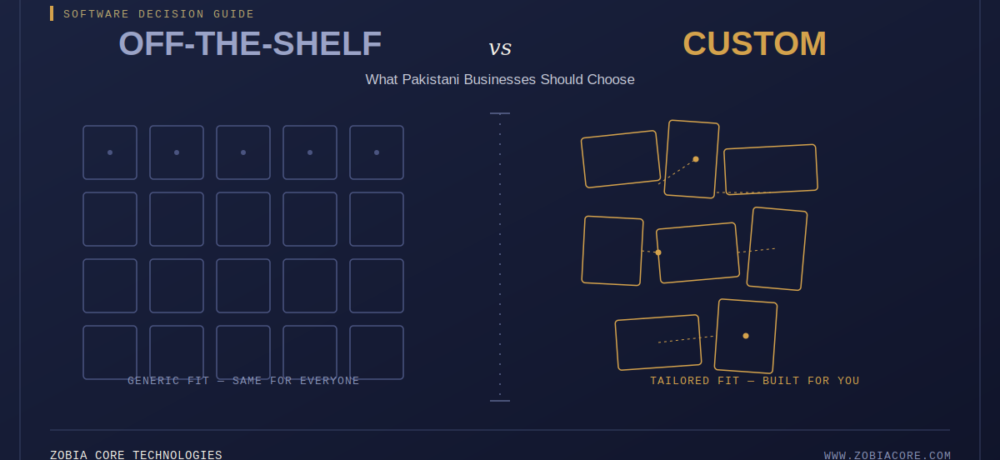
Off-the-shelf software is a pre-built product — think QuickBooks, generic POS systems, or a stock e-commerce theme — designed to serve thousands of businesses with roughly similar needs. You sign up, configure a few settings, and go.
Custom software is built from the ground up (or heavily tailored) around your specific workflows, data structures, and business rules. It’s slower to launch but fits like a glove instead of a borrowed jacket.
Neither is universally “better.” The right answer depends entirely on where your business is right now — and where it’s heading.
When Off-the-Shelf Actually Makes Sense
Let’s be honest about this first, because a lot of “custom software vs off-the-shelf” content online is written by agencies trying to upsell everyone into custom builds. That’s not honest advice.
Off-the-shelf is the smarter choice when:
- Your process is genuinely standard. Basic accounting, generic invoicing, or simple inventory tracking for a small retail shop rarely needs custom logic.
- You’re validating an idea. A new business testing demand shouldn’t sink capital into custom development before proving the model works.
- Budget and timeline are tight. You need something running this month, not in four months.
- The tool has strong local support and integrations already common in Pakistan (bank integrations, tax/FBR-compliant invoicing, etc.).
A small boutique or a single-location retail shop, for instance, is usually far better served spending a fraction of the cost on an existing POS system than commissioning a custom one.
Where Off-the-Shelf Starts Breaking Down
The problems usually surface 12–18 months in, once a business has grown past the “generic” stage. We’ve seen this pattern repeatedly with SMEs across Pakistan’s commercial hubs.
Take a mid-sized textile trading business operating out of Lahore as an illustrative example. It started with a popular off-the-shelf inventory tool — fine for year one. But textile trading involves lot-based stock, fabric-specific units (meters vs. yards vs. rolls), and multi-stage order approvals between sales, production, and dispatch teams. The off-the-shelf tool had none of this logic. The workaround? Three separate spreadsheets running alongside the software, manually reconciled every evening. That’s not a software solution anymore — that’s a second, unpaid job for someone on the team.
A similar pattern shows up with logistics and distribution SMEs based in Karachi. Off-the-shelf fleet or delivery-tracking apps are typically built for a “one size fits most” delivery model — but a distributor running mixed retail and wholesale delivery routes, with different pricing tiers and credit terms per client, quickly outgrows the software’s rigid assumptions. Every “customization request” to the vendor either isn’t possible or costs almost as much as building it custom in the first place — except now it’s built on someone else’s foundation, with someone else’s roadmap priorities.
This is the real cost of off-the-shelf software at scale: it’s not the subscription fee, it’s the hidden operational cost of working around what the software can’t do.
The Real Cost Comparison (Beyond the Price Tag)
| Factor | Off-the-Shelf | Custom Software |
|---|---|---|
| Upfront cost | Low | Higher |
| Time to launch | Days to weeks | Weeks to months |
| Fit to your exact workflow | Approximate | Exact |
| Scalability with growth | Limited, forces workarounds | Built to grow with you |
| Ownership of data & logic | Vendor-controlled | Fully yours |
| Long-term cost (3–5 years) | Often higher (add-ons, workarounds, lost productivity) | Predictable, one-time investment |
| Competitive differentiation | None — your competitors use the same tool | Becomes a business asset |
That last row matters more than most SMEs realize. If you and your three closest competitors are all running the exact same off-the-shelf CRM with the exact same limitations, it’s not actually helping you compete — it’s just table stakes.
A Simple Framework to Decide
Ask these four questions honestly:
- Is our workflow actually unique, or do we just think it is? Many businesses assume their process is special when it’s actually fairly standard. Be honest here.
- Are we spending more than 3–5 hours a week on manual workarounds because the current tool doesn’t fit? If yes, that’s a recurring cost that compounds every month.
- Will this software still fit us in 2–3 years, or are we already close to outgrowing it?
- Does this system touch our core competitive advantage — pricing logic, customer data, production process — or is it a back-office utility?
If workflows are non-standard, workarounds are eating real time, growth is on the horizon, and the system touches your competitive edge — custom development pays for itself. If none of those apply, save your budget and go off-the-shelf.
A Middle Path: Hybrid Approach
Many SMEs don’t need to choose one extreme. A common, cost-effective path is:
- Keep off-the-shelf tools for genuinely standard functions (basic accounting, email, HR)
- Build a custom layer or integration only for the specific workflow that’s actually unique to your business (custom order management, industry-specific inventory logic, a client portal)
This hybrid model is often what makes the most financial sense for businesses in the PKR 5–50 lakh software budget range — full custom builds aren’t always necessary; targeted custom modules that plug into existing tools frequently deliver 80% of the benefit at a fraction of full custom cost.
Final Thought
The businesses that make this decision well aren’t the ones chasing the trendiest option — they’re the ones that map their actual workflow honestly before writing a single requirement document. Off-the-shelf isn’t “cheap and inferior,” and custom isn’t “expensive and superior.” They’re two different tools for two different stages of business maturity.
If you’re not sure which stage you’re in, that itself is a useful starting conversation — usually a 30-minute workflow audit makes the right path obvious.
Zobia Core Technologies builds custom software solutions for growing businesses across Pakistan. If you’re weighing custom development against an off-the-shelf tool for your specific workflow, get in touch for a free consultation.