
“How much will it cost?” is almost always the first question a business asks — and almost never the first question a software company can answer honestly in one sentence. The real answer depends on scope, complexity, and who’s building it. But “it depends” isn’t useful when you’re trying to set a budget.
So this guide does something most pricing pages won’t: it gives you actual ranges, explains exactly what moves the number up or down, and shows you how to sanity-check any quote you receive — whether it’s from us or anyone else.
What Actually Drives the Price
Before the numbers, understand the five levers that determine cost. Every quote you’ll ever receive is really just these five factors combined:
- Scope and feature count — a login screen and a payment gateway are both “features,” but one takes 3 hours and the other takes 30.
- Complexity of business logic — a simple content website vs. software with approval workflows, role-based permissions, and third-party integrations.
- Platform — web only, mobile only, or both (each platform roughly adds its own development cycle).
- Team seniority and structure — a single freelancer, a small dedicated team, or a full agency with QA and project management built in.
- Design depth — a functional UI vs. a fully custom-designed, brand-matched interface.
Two businesses asking for “an app” can get quotes PKR 300,000 apart — and both quotes can be completely fair, because they’re not actually asking for the same thing.
Typical Software Development Costs in Pakistan (2026)
These are realistic market ranges based on typical project scopes we see across Pakistani SMEs. Treat them as planning benchmarks, not fixed quotes — your exact number depends on the five factors above.
| Project Type | Typical Cost Range (PKR) | Typical Timeline |
|---|---|---|
| Basic business website (5–8 pages, CMS) | 60,000 – 200,000 | 2–4 weeks |
| E-commerce store (standard features) | 200,000 – 600,000 | 4–8 weeks |
| Custom web application (business logic, dashboards) | 500,000 – 2,000,000 | 2–4 months |
| Mobile app (single platform, standard features) | 400,000 – 1,500,000 | 2–4 months |
| Mobile app (iOS + Android, moderate complexity) | 900,000 – 3,000,000 | 3–6 months |
| Custom ERP / CRM / inventory system | 1,000,000 – 5,000,000+ | 3–8 months |
| SaaS MVP (minimum viable product) | 800,000 – 3,500,000 | 2–5 months |
| Ongoing maintenance & support | 15,000 – 100,000/month | Ongoing |
A note on why these ranges are wide: a “custom ERP” for a 15-person trading business and a “custom ERP” for a 200-employee manufacturer are both accurately described by that phrase, but they’re not the same project. This is exactly why serious software companies ask detailed scoping questions before quoting — anyone who gives you an exact number in the first five minutes is guessing, not scoping.
Hourly Rates: What Developers Actually Cost
If you’re hiring on an hourly or dedicated-resource basis rather than a fixed project, it helps to know the underlying market. Compensation data for software professionals in Pakistan shows meaningful variation by experience level — <cite index=”1-1″>average software developer compensation nationally works out to roughly Rs 1,600 per hour equivalent, with entry-level professionals earning notably less and senior developers (8+ years) earning considerably more</cite>. Independent hourly-rate benchmarking data shows a similarly wide spread depending on specific skill and seniority, <cite index=”3-1″>with reported average hourly rates ranging from roughly Rs 1,000 up to Rs 8,000</cite> across different specializations and experience tiers.
For client-facing agency work (which bundles in project management, QA, and business overhead — not just raw coding time), expect quoted hourly rates to run higher than raw developer compensation alone. As a planning rule of thumb for the Pakistani market in 2026:
- Junior developer / hourly rate: PKR 1,500 – 2,500
- Mid-level developer: PKR 2,500 – 4,500
- Senior developer / architect: PKR 4,500 – 8,000+
- Full agency team (dev + QA + PM bundled): PKR 3,500 – 6,000 blended average
Fixed Price vs. Hourly vs. Dedicated Team: Which Should You Choose?
Fixed price works when requirements are clear and unlikely to change — a defined website, a known feature set. You know your total cost upfront, but changes mid-project usually mean formal change requests (and added cost).
Hourly/time-and-materials works when requirements will evolve — a product being built iteratively, or ongoing feature additions. You get flexibility, but need to actively track progress against budget.
Dedicated team works when you need sustained, long-term development capacity — effectively an extension of your own team, billed monthly. This is common for SaaS products and businesses with a continuous software roadmap rather than a single project.
Most SMEs starting their first serious software project are better off with fixed price for a clearly scoped first phase, then switching to hourly or dedicated-team for ongoing iteration once the product proves itself.
Regional Cost Variance: Karachi & Islamabad vs. Multan
Where your development team is based genuinely affects the quote — and this surprises a lot of first-time buyers.
Software companies based in Karachi and Islamabad typically carry higher overhead: office rent, higher local salary expectations (driven by cost of living and a denser concentration of multinational employers competing for the same talent pool), and often a premium built into pricing simply because of brand recognition and client volume from larger enterprises.
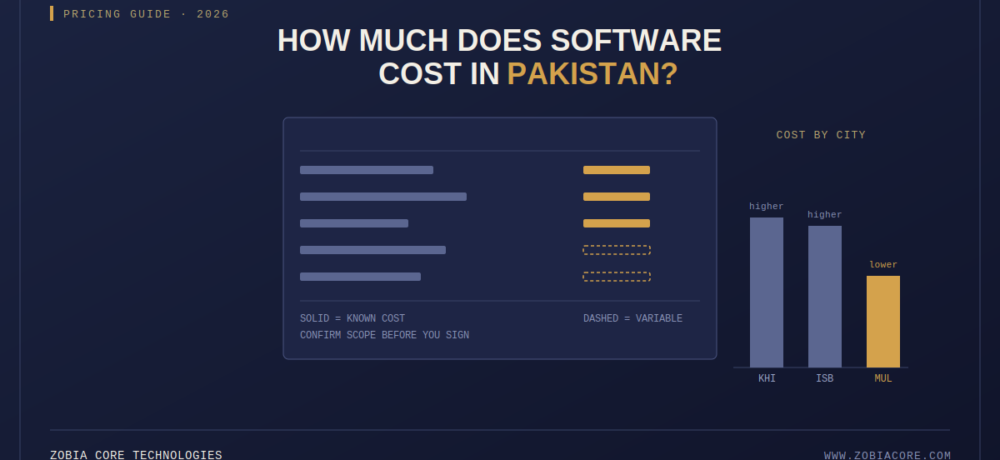
Companies based in Multan and similar tier-2 cities generally operate with meaningfully lower overhead — office costs are a fraction of Karachi/Islamabad rates, and this typically translates into a 20–35% lower quote for comparable work, without a corresponding drop in code quality or delivery standards. Multan’s growing tech talent pool (fed by local universities and increasing remote-work normalization) means the “smaller city, smaller ability” assumption doesn’t really hold anymore — the difference is overhead structure, not skill ceiling.
The practical takeaway: if your project doesn’t require in-person meetings every week, it’s worth getting quotes from outside the metro-city premium. Many Pakistani businesses headquartered in Karachi or Lahore already work with tier-2-city development partners remotely — the entire industry operates this way now, and video calls plus proper documentation close the distance gap completely.
Hidden Costs Businesses Often Forget to Budget For
A quote covering “development” often doesn’t automatically include:
- Hosting and server costs (ongoing, separate from the build)
- Third-party API/service costs (payment gateways, SMS gateways, maps — often billed by usage)
- App store fees (Apple Developer Program is an annual fee; Google Play is a one-time fee)
- Post-launch bug fixing window — confirm how many days/weeks of free fixes are included after go-live
- Domain and SSL renewal (small, but recurring)
- Content and data migration if replacing an existing system
- Training time for your team to actually use the new system
Ask about every item on this list before signing — not after the invoice arrives.
A Quick Sanity-Check Before You Accept Any Quote
- Does the quote break down by feature/module, or is it one lump number? (Lump numbers hide scope gaps.)
- Is there a written scope document, or just a verbal agreement? (Verbal scope = scope creep waiting to happen.)
- What’s explicitly excluded? (Hosting, third-party fees, revisions beyond X rounds?)
- What happens if requirements change mid-project? (Change request process should be defined upfront.)
- Who owns the code and source files after final payment? (This should always be you — confirm it in writing.)
Final Thought
The cheapest quote and the right quote are rarely the same number. The businesses that end up happiest with their software investment aren’t the ones who found the lowest price — they’re the ones who understood exactly what was (and wasn’t) included before they signed anything.
If you’re planning a software project and want a realistic, itemized estimate rather than a guess, scope it properly before you budget around a number you saw on a blog.
Zobia Core Technologies provides transparent, itemized quotes for custom software, mobile apps, and business systems for clients across Pakistan. Request a free project estimate — no obligation, no vague numbers.