
Every founder eventually hits this decision, usually earlier than they’d like — often before the product even has a name, let alone a logo. You have limited runway, a rough idea of your users, and a co-founder or advisor pushing hard for one option while you’re leaning toward the other.
The honest answer isn’t “it depends” — that’s true but unhelpful. There’s an actual framework here, and it comes down to answering a handful of specific questions about your users, your business model, and how you plan to validate the idea before you’ve spent your entire seed budget building the wrong thing first.
Web App vs Mobile App: The Real Difference (Beyond the Obvious)
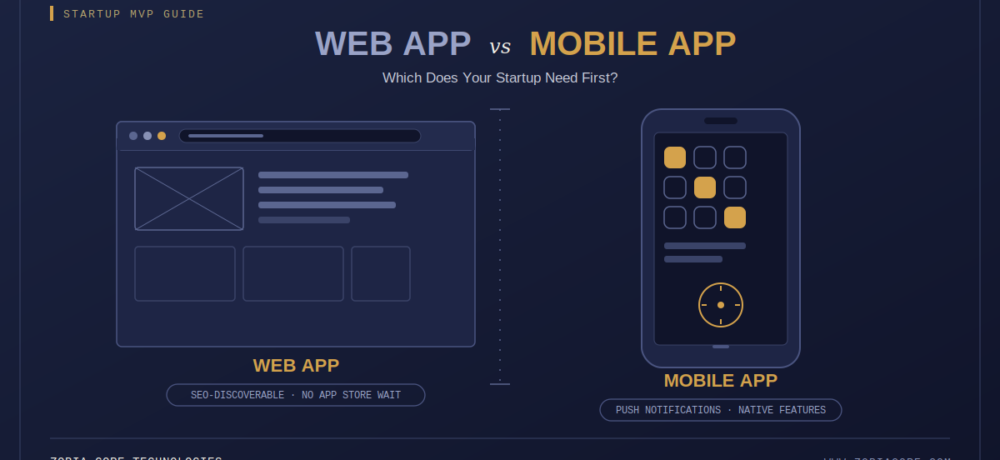
A web app runs in a browser — accessible from any device with an internet connection, no download required. Think of tools like Notion’s web version, most SaaS dashboards, or booking platforms.
A mobile app is installed from the App Store or Google Play, lives on the user’s home screen, and can access native device features — push notifications, camera, GPS, offline mode, biometric login.
The surface-level difference is obvious. The strategic difference is what actually matters, and it comes down to three things: how your users will find you, how often they’ll use you, and what your product actually needs to do.
Start With This Question: How Will Users Discover You?
This is the single most underrated factor in the entire decision.
- If your growth strategy relies on search engines, shared links, or content marketing, a web app wins by default — nobody can share a link to an app they’d have to convince someone to download first. Web apps are discoverable and frictionless; app stores are a wall between a curious visitor and your product.
- If your product lives or dies by users opening it multiple times a day — a habit-forming consumer app, something tied to notifications, or something people expect to use on the go — mobile wins, because it lives on the home screen and can actively pull users back in.
A B2B SaaS tool selling to office workers who’ll discover it through a Google search or a LinkedIn post has no business launching as a mobile-only app first. A ride-hailing or delivery app has no business launching as a web-only product first. The use case usually answers this question before you even get to budget.
The MVP Reality: Speed and Cost Matter More Than You Think
For a first-time founder validating an idea, this is where theory meets runway.
Web apps are generally faster and cheaper to build and iterate on. One codebase, no app store review process, instant updates pushed live without users needing to download anything. If your hypothesis is wrong and you need to pivot the core feature next week, a web app lets you do that without waiting days for app store approval.
Mobile apps carry real additional overhead: separate builds for iOS and Android (unless using cross-platform frameworks, which come with their own trade-offs), app store review delays (Apple’s review alone can take days), and ongoing OS-update maintenance that never fully stops.
This is precisely why most experienced founders and technical advisors will tell early-stage startups the same thing: validate the core hypothesis with a web app first, then build mobile once you have proof the demand is real. Spending 3-4 months and a large chunk of pre-seed capital on a mobile app before you know if anyone actually wants the product is one of the most common — and most avoidable — early-stage mistakes.
When Mobile-First Is Actually the Right Call
This isn’t a blanket “always start with web” rule. Some products genuinely need mobile from day one:
- Location-based products (delivery, ride-hailing, field service apps) that depend on GPS
- Products requiring offline functionality (field data collection, inventory scanning in low-connectivity areas)
- Camera or biometric-dependent products (document scanning, ID verification, AR features)
- High-frequency habit products where push notifications are core to the retention strategy, not a nice-to-have
- Payment or fintech products where users expect app-level security (biometric login, secure local storage)
If your product fits one of these categories, building a web-first MVP to “save money” often just means building the wrong MVP — you’d be testing a version of the product that can’t actually demonstrate the core value proposition.
A Quick Framework to Decide
Answer these four questions honestly:
- How will your first 100 users find you? Search/content/link-sharing → web. App store browsing/word-of-mouth install → mobile.
- Does your core value proposition require native device features (GPS, camera, push, offline)? If yes, mobile isn’t optional.
- What’s your validation timeline? Need to test and iterate weekly → web. Have runway and a validated concept already → mobile is viable.
- Is this B2B or B2C? B2B tools are overwhelmingly used on desktop/browser during work hours. B2C consumer products lean mobile far more often.
If your answers point in different directions, that’s normal — weigh discovery and validation speed most heavily for an unproven idea, and weigh core functionality most heavily for a validated one.
What We See Working for Startups in Practice
We’ve built MVPs for founders across very different starting points — from early-stage teams coming out of Islamabad’s startup and incubator scene to fintech and logistics founders building for Karachi’s fast-moving commercial market. The pattern holds up consistently regardless of city or sector: the startups that move fastest are the ones that resist the pressure to “build the app” before they’ve proven the core assumption with something lighter and faster to ship.
A common, cost-efficient middle path we recommend to early founders: build a responsive web app as the MVP (which also works reasonably well on mobile browsers), validate the core loop with real users, and only commit to native mobile development once retention and usage data justify the investment.
The Hybrid Option: Progressive Web Apps (PWAs)
Worth a mention for founders trying to split the difference: a Progressive Web App behaves like a hybrid — installable to a home screen, capable of push notifications and limited offline functionality, but built and deployed like a web app (single codebase, no app store approval process).
PWAs aren’t a perfect substitute for a fully native app — performance and access to some native features still lag behind true native apps — but for many early-stage products, a PWA closes a meaningful part of the gap at a fraction of native mobile development cost and timeline.
Final Thought
The founders who get burned on this decision almost always share the same root cause: they built for the product they imagined having in 18 months, not the product they needed to validate this quarter. Start with what proves your core hypothesis fastest and cheapest — the right platform decision follows naturally once you actually know your product works.
Zobia Core Technologies builds MVPs, web apps, and mobile apps for startup founders. If you’re not sure which one your idea actually needs, let’s scope it together before you commit budget to the wrong build.