Let me guess. You’ve got a solid business. Loyal customers, decent word-of-mouth, maybe a nice Instagram page you post on when you remember to. And somewhere in the back of your mind, there’s a voice saying, “Do I actually need a website? My customers find me anyway.”
Here’s the uncomfortable truth: they don’t find you. They find your competitor who showed up first on Google.
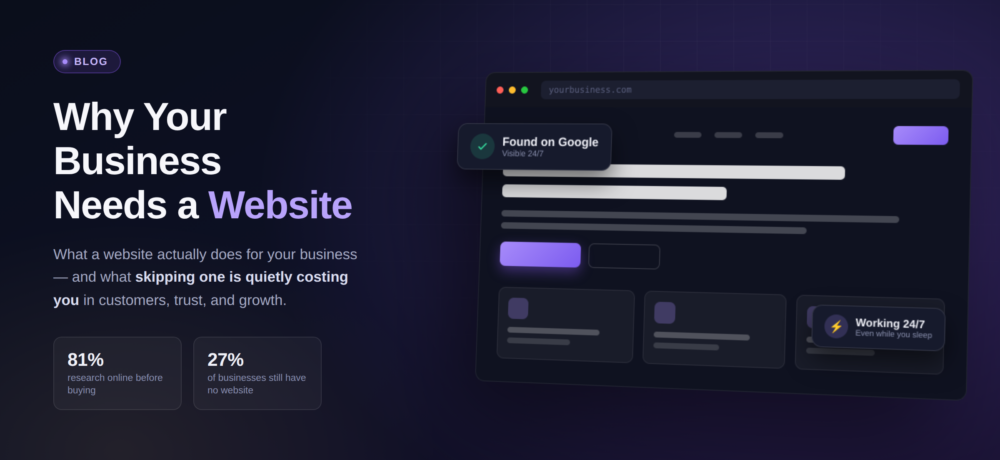
Right now, roughly 1 in 4 small businesses still don’t have a website — and 81% of consumers research a business online before they ever pick up the phone or walk through the door. That gap between “no website” and “customer already decided without you” is where businesses quietly lose money every single day, without ever knowing it.
In this post, I’m going to break down exactly what a website does for your business, what it’s really costing you not to have one, and why “just using social media” isn’t the substitute you think it is.
Let’s get into it.
The Real Benefits of Having a Business Website
1. You Show Up When People Are Already Looking For You
Every day, thousands of people search Google for exactly what you sell — “plumber near me,” “best bakery in [city],” “digital marketing agency in Multan.” If you don’t have a website, you don’t exist in that search. Period.
A website is the single biggest lever for organic visibility. Around 70% of all website traffic comes from Google, and search remains the #1 way people discover new businesses — ahead of referrals, ads, or social media.
Without a website, every one of those searches goes straight to a competitor.
2. Your Website Is Working 24/7 — Even While You Sleep
A physical store closes. A salesperson goes home. Your Instagram post gets buried under 50 newer posts by tomorrow morning.
Your website doesn’t do any of that. It answers questions, shows your services, takes bookings, and builds trust at 3 AM on a Sunday, without you lifting a finger. It’s the only “employee” that never clocks out.
3. First Impressions Are Made Before You Even Say Hello
Here’s a stat that should make every business owner pay attention: 94% of a customer’s first impression of a business is tied to design — and most of that first impression now happens on a website before any human interaction takes place.
If your only online presence is a Facebook page from 2019 or nothing at all, that is your first impression. And it’s not a good one.
4. It Builds Instant Credibility
Think about the last time you found a business with no website — just a phone number and maybe a Google listing. Did you trust it as much as one with a clean, professional site?
Most people don’t. A website signals legitimacy. It tells a customer: this is a real, established business, not someone who might disappear tomorrow. That trust directly affects whether someone chooses you over the next name on the list.
5. You Own It — Unlike Social Media
This is the one most business owners miss.
Your Instagram page, Facebook page, TikTok account — you don’t own any of that. The platform does. One algorithm change, one policy update, one account suspension, and your entire audience disappears overnight. It’s happened to thousands of businesses.
Your website is the one digital asset that’s actually yours. No algorithm decides who sees it. No platform can suspend it. You control it completely.
6. It’s a 24/7 Sales and Lead-Generation Tool
A good website doesn’t just sit there looking pretty — it actively converts visitors into leads and customers through contact forms, click-to-call buttons, booking systems, and clear calls to action. Done right, it’s not a cost center. It’s your best-performing salesperson, and it never asks for a day off.
7. It Lets You Compete With Bigger Businesses
A well-built website puts a small business on the same visual footing as a much larger one. Customers researching you side-by-side with a competitor often can’t tell company size from a website alone — what they can tell is which one looks more professional, loads faster, and answers their questions clearer. That’s a battle a small business can absolutely win.
What Not Having a Website Is Actually Costing You
It’s easy to think “no website” just means “missed opportunity.” In reality, it’s an active, ongoing cost. Here’s what it looks like:
- You’re invisible to 81% of consumers who research online before buying — they simply never find out you exist.
- You lose every comparison search. When someone searches “[your service] vs [competitor],” you’re not even in the conversation.
- You look less credible, even if your work or product is better. Perception often wins before quality gets a chance to.
- You’re 100% dependent on referrals and foot traffic, which puts a hard ceiling on how much your business can grow.
- You’re renting your audience, not owning it, if social media is your only online presence — and renting can be taken away at any time.
- You can’t run proper digital marketing. Ads, SEO, email marketing, retargeting — nearly all of it needs a website to actually work.
- You’re training customers to choose someone else. Every search where a competitor’s site shows up and yours doesn’t is a small, repeated lesson in who to trust next time.
None of this happens all at once. It happens quietly, search after search, customer after customer — which is exactly why so many business owners underestimate how much it’s really costing them.
“But I Have a Facebook Page — Isn’t That Enough?”
This is the question I hear the most, so let’s address it directly.
A social media page and a website are not interchangeable — they do completely different jobs:
| Website | Social Media Page | |
|---|---|---|
| You own it | Yes | No — the platform does |
| Shows up in Google search | Yes | Rarely, and unreliably |
| Full control over design & content | Yes | Limited to the platform’s format |
| Works as a 24/7 sales tool | Yes — forms, bookings, CTAs | Very limited |
| Builds long-term SEO value | Yes, compounds over time | No |
| Can disappear overnight | No | Yes — bans, algorithm changes, outages |
Social media is a great addition to a website. It’s a poor replacement for one. The strongest businesses use both — a website as the foundation, social media to drive traffic to it.
“Isn’t a Website Expensive?”
This is usually the real objection hiding behind “I don’t need one.”
Here’s the honest answer: a website is not the expense — not having one is. Every day without a proper online presence is a day of lost searches, lost trust, and lost customers that a competitor is quietly collecting instead.
And the cost of building one has dropped dramatically. What used to require a large budget and months of development can now be done efficiently, professionally, and affordably — especially when you work with a team that builds it right the first time instead of needing a rebuild in a year.